What Is a Proprietary Blend? 5 Steps to Read One, With CogniMary's 635 mg
You will meet this phrase on supplement labels, and the label rarely explains it. Here is a plain definition, then five steps to read any blend, with the CogniMary label as the worked example.
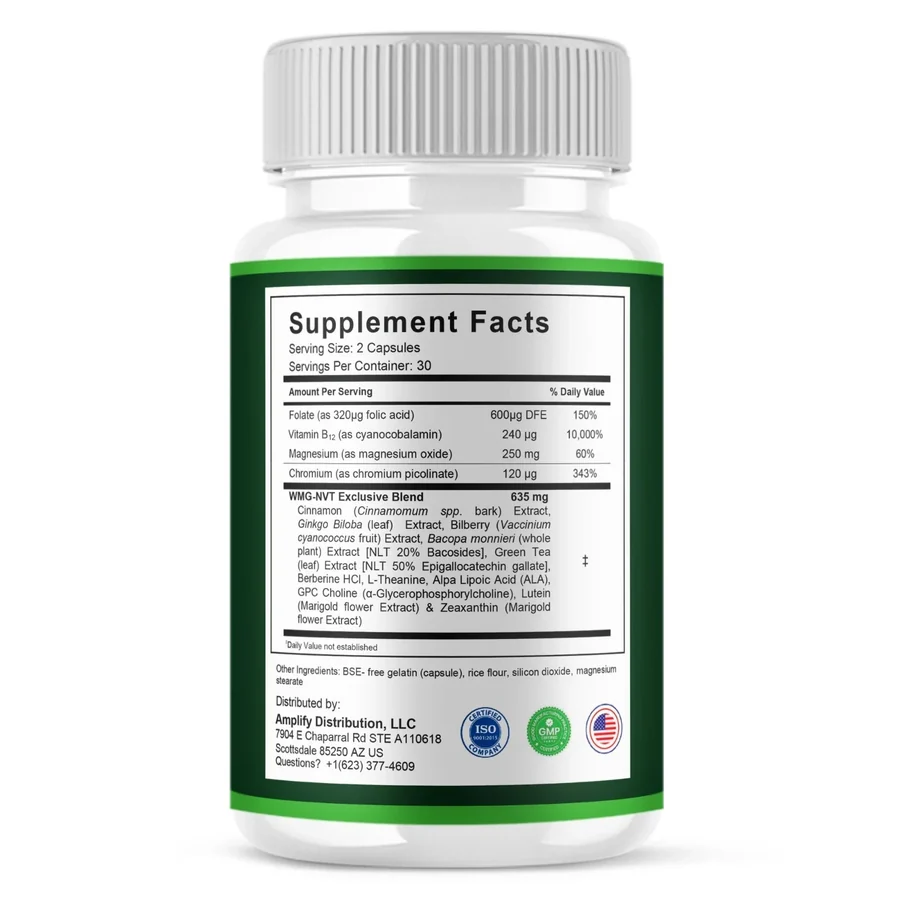
A proprietary blend is a group of ingredients listed with one total weight instead of an amount for each. US rules allow it, but require the names in descending order by weight. That order gives each ingredient a ceiling. CogniMary's blend is 635 mg shared by eleven ingredients.
- Key facts
- Step 1: What is a proprietary blend, in plain words?
- Step 2: Why do blends exist?
- Step 3: How do you find the total and count the names?
- Step 4: How do you divide by position?
- Step 5: How do you compare, and what do you ask the seller?
- What does the label show about the blend?
- What does a blend cost the buyer?
- What can the ceiling not tell you?
- What does an open label look like instead?
- How do you read a blend with a phone in a shop?
- What else does the printed order tell you?
- Frequently asked questions
- Which sources explain the blend rule?
- Our view
Key facts
- The rule is 21 CFR 101.36(c). The blend carries a name and one total weight on the same line.
- Names inside the blend must appear in order of weight, heaviest first, with no amount for each.
- CogniMary's blend is the WMG-NVT Exclusive Blend: 635 mg, 11 ingredients.
- The ingredient in position k can weigh at most 635 divided by k.
- The split is not published. The ceilings are limits, not measurements.
Step 1: What is a proprietary blend, in plain words?
Think of a soup recipe that lists eleven things and one total weight, and refuses to say how much of each went in. That is a proprietary blend. The label shows a name, a total weight and a list of ingredient names.
The law behind it is 21 CFR 101.36(c). The name can be "Proprietary Blend" or another descriptive or fanciful name. On CogniMary the name is WMG-NVT Exclusive Blend. The total weight goes on the same line, and the names are indented below.
If you were searching for the definition of a proprietary blend, or for what a proprietary ingredient is, this is it: a named group of ingredients sold under one total.
Step 2: Why do blends exist?
There is an honest case, and it is worth hearing before the criticism.
- Copying. A full recipe on a shelf can be matched and undercut by a rival.
- Ratios. In some formulas the proportions are the real invention.
- Supply. Extract strength shifts between harvests, so one total is easier to hold steady than eleven figures.
All three are real. None of them helps a buyer who needs to check a dose, and none helps a pharmacist who needs an amount.
Step 3: How do you find the total and count the names?
Find the line with the blend name and one weight. On CogniMary it is 635 mg. Now count the names under it. There are eleven.
Shared out equally, eleven names would get about 58 mg apiece out of the 635 mg. The real split is not even, because the list runs from heaviest to lightest. Still, the sum tells you something: a long list inside a small total is crowded.
Step 4: How do you divide by position?
The first name is the heaviest. The last is the lightest. So the ingredient in position k cannot be heavier than the total divided by k. For CogniMary that is 635 divided by k.
| Position | Ingredient | Ceiling |
|---|---|---|
| 1 | Cinnamon extract | 635.0 mg |
| 2 | Ginkgo biloba extract | 317.5 mg |
| 3 | Bilberry extract | 211.7 mg |
| 4 | Bacopa monnieri extract | 158.8 mg |
| 5 | Green tea extract | 127.0 mg |
| 6 | Berberine HCl | 105.8 mg |
| 7 | L-theanine | 90.7 mg |
| 8 | Alpha lipoic acid | 79.4 mg |
| 9 | GPC choline | 70.6 mg |
| 10 | Lutein | 63.5 mg |
| 11 | Zeaxanthin | 57.7 mg |
Step 5: How do you compare, and what do you ask the seller?
Look up the dose a study used for the ingredient you care about, then set it beside the ceiling. Bacopa was studied at 300 mg a day and its ceiling here is 158.8 mg. Berberine was studied at 1,500 mg a day and its ceiling is 105.8 mg. Six of the eleven cannot reach their studied dose.
Then ask. Five questions are fair for any blend:
- How many milligrams of each ingredient are in a serving?
- What extract ratio or standardisation applies to each plant?
- Which species is the bilberry, and is there an identity test?
- How much EGCG is in a serving?
- Is a certificate of analysis available for the lot I received?
This site is the retailer's, and it does not hold the split. The order desk takes the same questions and can pass them on.
What does the label show about the blend?
| Fact | What is published |
|---|---|
| Blend name | WMG-NVT Exclusive Blend |
| Blend weight | 635 mg |
| Names under it | Eleven, listed heaviest first |
| Individual amounts | Not published |
| Nutrients outside the blend | Folate, vitamin B12, magnesium and chromium, each with an amount |
| Serving | Two capsules |
| Certificate of analysis | None published, so no potency test is on view |
| Lot reference supplied | COG-26/GO-2760 |
What does a blend cost the buyer?
- You cannot check a dose against the research.
- You cannot compare two products that name the same ingredients.
- You cannot judge whether an expensive ingredient sits in trace amounts.
- You cannot give a clinician an amount for an interaction.
- No outsider can study the formula and report exactly what was given to people.
That last point is easy to miss. A blend hides the formula from buyers and also from the research record.
What can the ceiling not tell you?
It is a limit, never a measured amount. It assumes the label follows the ordering rule. It says nothing about extract strength, since a concentrated extract can do more per milligram. And it cannot speak to combination effects, which may exist but have not been tested for this formula.
So read the ceilings as limits. If the seller ever publishes the split, every ceiling becomes unnecessary, and the site says it will replace them with the real figures.
What does an open label look like instead?
| Blend label | Open label |
|---|---|
| One total, eleven names below it | Eleven lines, each with a number |
| A ceiling can be worked out; the content cannot | The content is stated |
| Two products cannot be compared | Comparing is plain arithmetic |
| Protects a formula from copying | Gives the formula away |
Both are legal. The difference is how much the seller chooses to tell you, and that says something about the seller as well as the product.
How do you read a blend with a phone in a shop?
- Blends can be stacked. A product may carry two or three, each with its own total, so divide each separately.
- Anything printed outside a blend comes with a real amount. Read those lines first.
- An ingredient named both inside and outside a blend is an odd case. Trust the quantified line.
- A three-name blend gives generous ceilings and tells you little. A fifteen-name blend tells you a great deal.
- A blend that shows no total breaks the rule. Walk away.
What else does the printed order tell you?
The first name is the heaviest. On this label that is cinnamon, a kitchen spice, in a blend sold for memory and focus. Ginkgo is second. GPC choline, the ingredient with the most encouraging recent trial, sits ninth.
If the ingredient an advert is built around sits near the bottom, the advert is built around a trace. And the last name can never beat the 57.7 mg ceiling that comes with eleventh place in this blend.
Frequently asked questions
What is a proprietary blend?
A group of ingredients listed with one total weight instead of an amount for each. The label must still name each ingredient in the blend and order the names by weight, heaviest first.
What is a proprietary blend definition under US rules?
21 CFR 101.36(c) lets a label identify a blend by a descriptive or fanciful name and print its total weight. Beneath it, the ingredient names are indented and run from heaviest to lightest, with no amounts.
What is a proprietary ingredient?
The rule speaks of a proprietary blend of dietary ingredients, and this label does not define a single proprietary ingredient. What CogniMary has is a named blend, the WMG-NVT Exclusive Blend, that holds eleven ingredients with no individual amounts.
What amount of each ingredient does CogniMary's blend hold?
It is not published. The total is 635 mg. The most each position could weigh is 635 divided by its place in the printed list, for example 317.5 mg for the second ingredient.
Are proprietary blends safe?
A blend is a labelling choice, not a safety grade. The practical risk is that you cannot tell a clinician an amount, for example for ginkgo with blood thinners. Ask a pharmacist and bring the panel.
Which sources explain the blend rule?
- U.S. Government Publishing Office21 CFR 101.36, Nutrition labeling of dietary supplements (eCFR.gov) · source
- Kongkeaw, Dilokthornsakul, Thanarangsarit et al., 2014Meta-analysis of randomized controlled trials on cognitive effects of Bacopa monnieri extract (Journal of Ethnopharmacology, PMID 24252493) · source
- Snitz, O'Meara, Carlson et al., 2009Ginkgo biloba for Preventing Cognitive Decline in Older Adults: A Randomized Trial (JAMA, PMID 20040554) · source
- European Food Safety Authority, 2018Scientific opinion on the safety of green tea catechins (EFSA Journal, DOI 10.2903/j.efsa.2018.5239) · source
Our view
A proprietary blend is legal and common. It is also the single biggest gap on this label, and the one most worth understanding. The ordering rule is the buyer's one lever, and it costs a phone calculator and ten seconds to use.
Use it on this label and on any other. If the ceiling sits under the studied dose, the product cannot copy the study, whatever the front says. If you still want the product, you are choosing with the numbers in view.
Medical note
CogniMary is a dietary supplement. It is not FDA approved, and no dietary supplement is. It is not a treatment for memory loss, dementia or any condition. If memory changes are new or getting worse, see a doctor first. If you take medicines, ask a doctor or pharmacist before you start.
Last updated